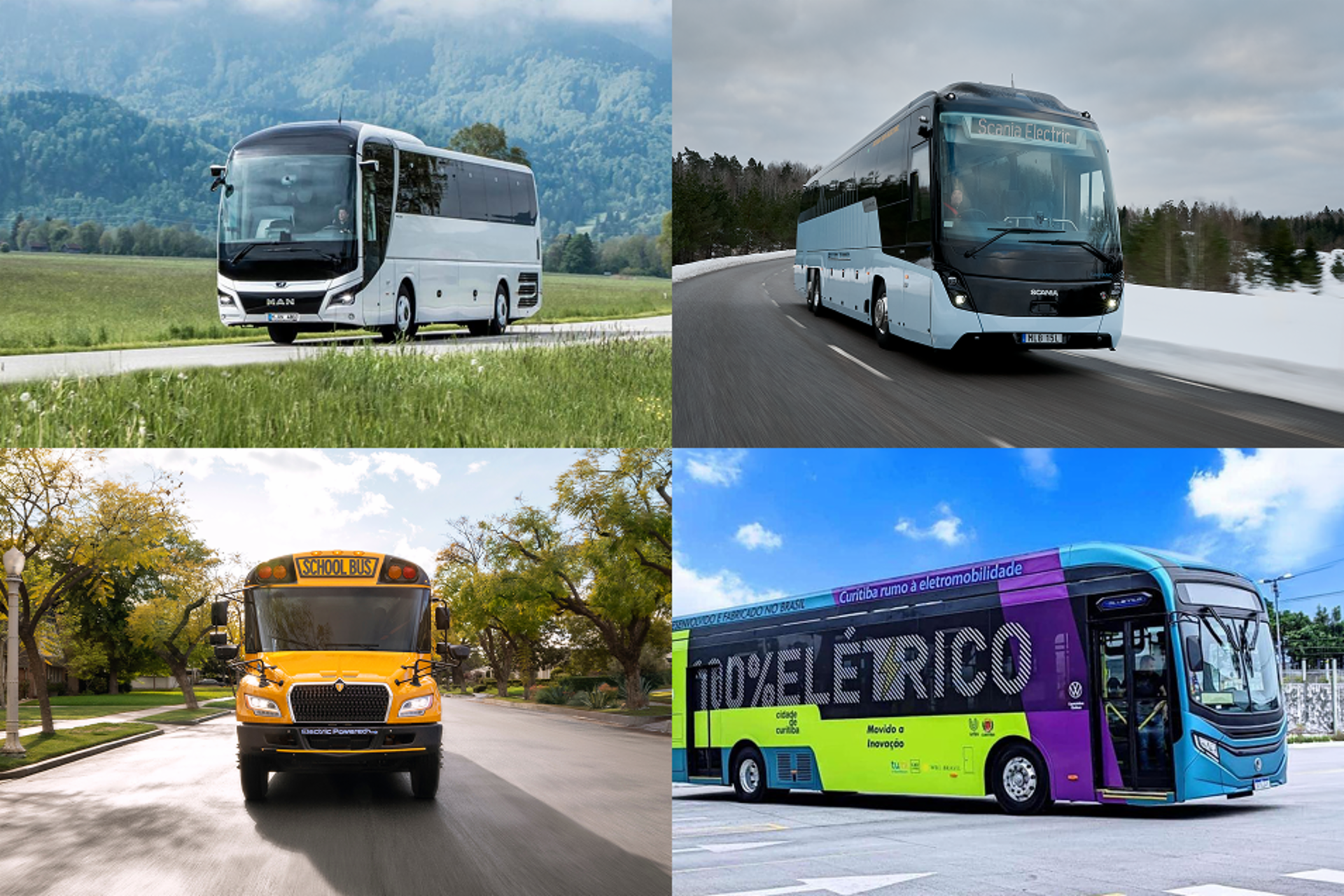
Electric in Every Segment – The TRATON GROUP’s eBus Portfolio
Disclaimer: This page and the documents, information, data and assessments contained herein reflect the factual and legal status as well as the corporate strategy at the time of their publication and/or for the time period specified. They may since have become outdated as they are not being updated.
From city bus to coach: today, the TRATON GROUP offers an electric solution in every segment. A look at its diverse portfolio shows just how far the shift to more sustainable transport has already come in the world of buses.
In 2019, MAN handed over two fully electric Lion’s City E as pre-series vehicles to the Hamburg transit operators Hamburger Hochbahn and VHH. Seven years later, the brands of the TRATON GROUP have now reached the next milestone: in every bus segment, they offer a fully electric solution – from the compact city bus to the long-distance coach. And they do so across four continents. For more sustainable mobility, that is another important step into the future.
“Being able to offer an electric solution in every bus segment today is the result of many years of development work across our brands,” says Birol Kilinc, who is responsible for the bus vehicle portfolio at TRATON. “Our customers can now opt for electric drivelines across the board – whether in city, intercity or long-distance service.”
From pre-series eBus to a complete electric portfolio
2019
The starting point
MAN hands over the first two fully electric Lion’s City E as pre-series vehicles to the Hamburg transit operators Hamburger Hochbahn and VHH.
Following the series production start of the 12-metre MAN Lion’s City E in autumn 2020, the articulated version enters series production in 2021. At the same time, many European cities are moving from trial projects to regular scheduled service with electric city buses.
Scania introduces its battery-electric bus platform for its bodybuilder partners. In North America, IC Bus introduces the next generation of the CE Series, further expanding its range of battery-electric school buses.
MAN opens the intercity segment with the Lion's City 12 E LE and premieres its first electric coach, the Lion's Coach 14 E, at Busworld in Brussels; Scania presents its first electric coach chassis and the Irizar i6S plug-in hybrid coach; and in Brazil the e-Volksbus 22L enters series production.
Heinz Kiess is Head of Product Marketing Bus at MAN and has witnessed the transformation up close. “Three or four years ago, the most common question was: Does this really work?” he recalls. “Today, customers ask: When can we get more?” The numbers speak a clear language: MAN has delivered around 3,300 electric buses since its market launch, which have now covered more than 250 million kilometers. Today, roughly every second city bus sold by MAN in Europe is electrically powered. Range anxiety – for years the skeptics’ standard argument – has dissolved in the light of real-world experience: in Munich, operators achieve around 350 kilometers per charge in daily scheduled service. In a test run in Spain, it was more than 500.
But MAN did not stop at the city bus. Since 2025, the Lion’s City 12 E LE has been opening up the intercity segment – a market long considered too demanding for purely electric drivetrains. And with the Lion’s Coach 14 E, which celebrated its world premiere at Busworld 2025 in Brussels, MAN took the leap into the coach segment. Its specs: up to 650 kilometers of range, an aerodynamic design optimized for minimal drag, and battery packs from its own plant in Nuremberg. “The coach is the ultimate challenge,” says Kiess. “That’s where customers talk about cents per kilometer. They want to know whether it pays off. And we can show them that it does.”
“We don't just build electric buses. We accompany our customers along the entire journey – from the first feasibility analysis, through the charging infrastructure, to daily operation.”
Heinz KiessHead of Product Marketing Bus, MAN
Scania: The Platform Specialist
While MAN mainly sells complete buses in Europe that go straight into service from the factory, the Group’s Swedish brand Scania takes a completely different approach. Scania doesn’t build complete buses; Scania builds platforms. “We supply the electrified chassis, and our bodybuilder partners build the bus that suits their market,” explains Carl-Johan Lööf, Head of Solution Strategy at Scania Group. “Irizar in Spain, Caetano in Portugal, Marcopolo in Brazil, Higer in China: they all work from the same technological foundation, but every bus looks different and meets different requirements.”
Just how flexible this system is becomes clear from the range of chassis. Since 2023, Scania has offered an electric chassis with a low, step-free entrance for city and intercity service – initially with two axles, and since April 2025 also with three axles for more passengers. And at Busworld 2025, the company presented its first electric coach chassis, which the Portuguese bodybuilder Caetano builds into a finished bus. It delivers up to 600 kilometers of range and can be charged comparatively quickly at 325 kilowatts.
Another remarkable vehicle presented at the show was the Scania Irizar i6S Efficient, a plug-in hybrid coach (PHEV). It has a diesel engine plus an electric drive, yet can also run up to 70 kilometers on electric power alone. “Electrification isn’t all or nothing,” Lööf explains. “In markets where the charging infrastructure isn’t in place yet – such as parts of Latin America, Australia, or many intercity routes – customers need a solution that works today. The hybrid coach is that solution.” Demand proves him right: more than 300 customers sought information at Busworld, and the interest came from well beyond Europe.
“We supply the electrified chassis, and our bodybuilder partners build the bus that suits their market.”
Carl-Johan LööfHead of Solution Strategy, Scania
Electric Across Four Continents
Because electric mobility in buses has long ceased to be a purely European affair. In Latin America, Volkswagen Truck & Bus has put the e-Volksbus 22L on the road – a 13.2-meter city bus that has been in series production at the Resende plant since June 2025. The first 260 units have been sold, and field tests in São Paulo and Salvador show excellent results in performance and range. A symbolic milestone: the 1,250,000th vehicle produced at the Resende plant was an e-Volksbus.
In North America, IC Bus – the bus division of TRATON subsidiary International Motors – serves the school bus segment with the CE Series Electric. It’s a market with rules of its own: fixed routes, predictable charging windows, but thousands of different school districts with differing budgets and requirements. That is why IC Bus complements the vehicle with a comprehensive advisory offering – from route simulation to funding guidance.
The Advantage of a Group
However differently MAN and Scania approach the market – one predominantly with complete buses, the other with chassis – at their core both draw on the same technology. At the cell level, they use the same technology, but produce the battery packs separately: MAN at its own plant in Nuremberg, Scania in Södertälje. “That is the real advantage of belonging to a group,” says Birol Kilinc. “With MAN and Scania, we have two brands that operate independently in the market but share a common technological base. That lowers costs, accelerates development, and gives both the freedom to play to their own strengths.”
“Being able to offer an electric solution in every bus segment today is the result of many years of development work across our brands. Our customers can now opt for electric drivelines across the board – whether in city, intercity or long-distance service.”
Birol KilincExpert Technology Strategy, TRATON
This shared foundation is the Group’s real advantage – and it reaches beyond Europe. Because TRATON’s two other bus brands also build on the Group’s electric technology, much of which comes from the truck side: in Latin America, the e-Volksbus from Volkswagen Truck & Bus draws on the technology of the electric e-Delivery truck, while in North America, IC Bus builds its electric school bus on a proven commercial-vehicle chassis. In this way, each brand benefits from the scale of the Group – while staying close to its own market. On top of that come jointly developed drivetrain components, a Group-wide diagnostics system, and a service network in numerous countries around the world. And just as with trucks, customer needs feed into central Group product management, which coordinates the portfolio across all brands so they complement one another rather than compete.
Thanks to this cooperation, seven years after the first eBuses for Hamburg there is now an electric answer from the TRATON GROUP in every bus segment. This was made possible by many years of development work and thousands of test and real-world kilometers. The result is a diverse portfolio that does justice to the diversity of the markets. Every electric bus that proves itself in service also strengthens confidence in the electrification of commercial vehicles as a whole. “We don’t just build electric buses,” says Kiess. “We accompany our customers along the entire journey – from the first feasibility analysis, through the charging infrastructure, to daily operation. That is what makes the difference.”