Megawatt charging for electric trucks: How MCS makes the most of the 45-minute break
Disclaimer: This page and the documents, information, data and assessments contained herein reflect the factual and legal status as well as the corporate strategy at the time of their publication and/or for the time period specified. They may since have become outdated as they are not being updated.
Battery-electric trucks are here, and they are proving themselves in daily operation. What still holds back electric long-haul transport is charging on the road. Whether the transition to electric succeeds depends, among other things, on one question: can a truck charge during the driver’s legally required 45-minute break?
After four and a half hours behind the wheel, truck drivers in the EU are required to take a 45-minute break. What sounds like a footnote in labor law is in fact the benchmark for every charging technology in long-haul transport: can the battery take on enough energy within those 45 minutes for the truck to get back on the road as soon as the driver’s break is over? If not, the vehicle sits idle longer than necessary. Day after day, trip after trip.
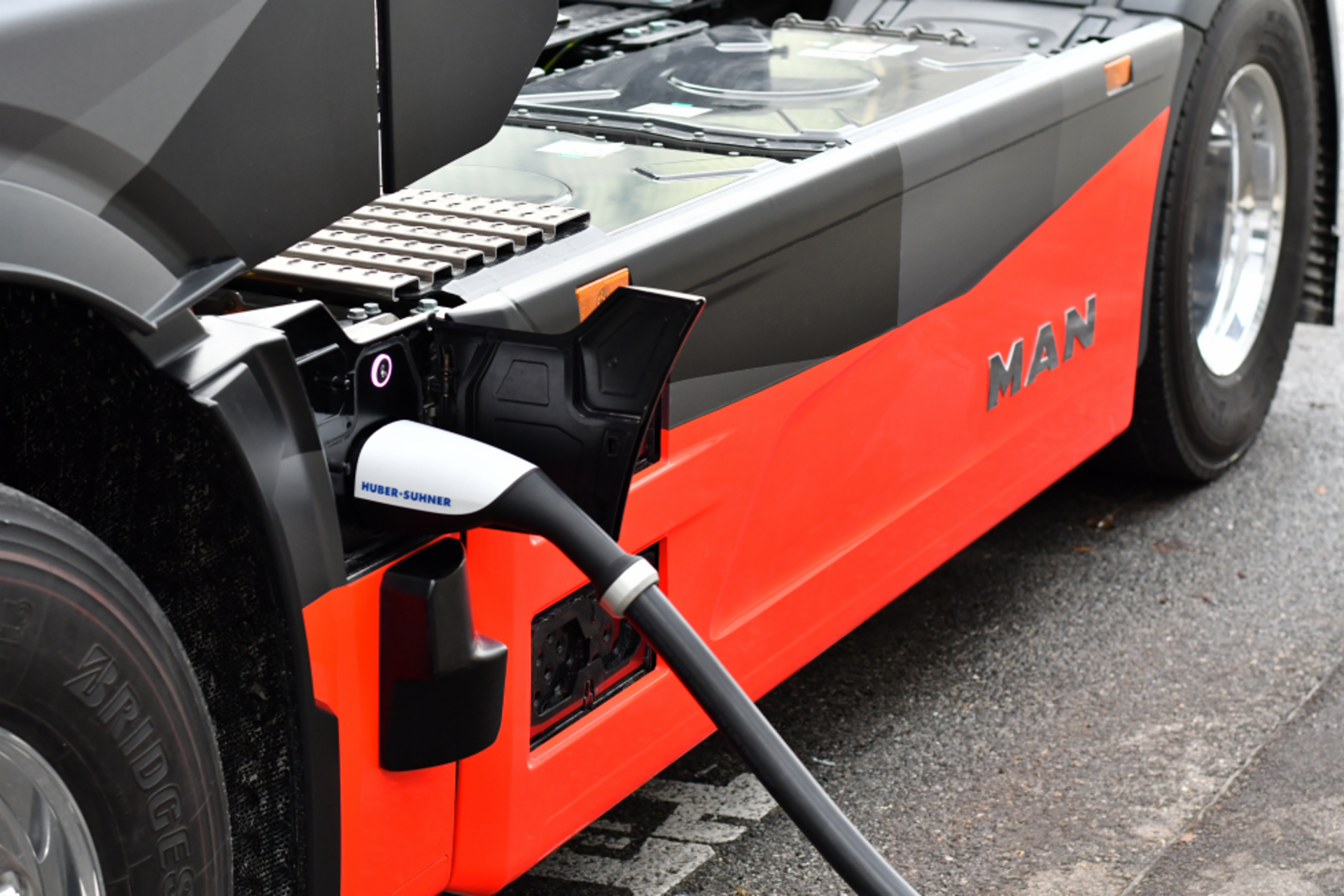
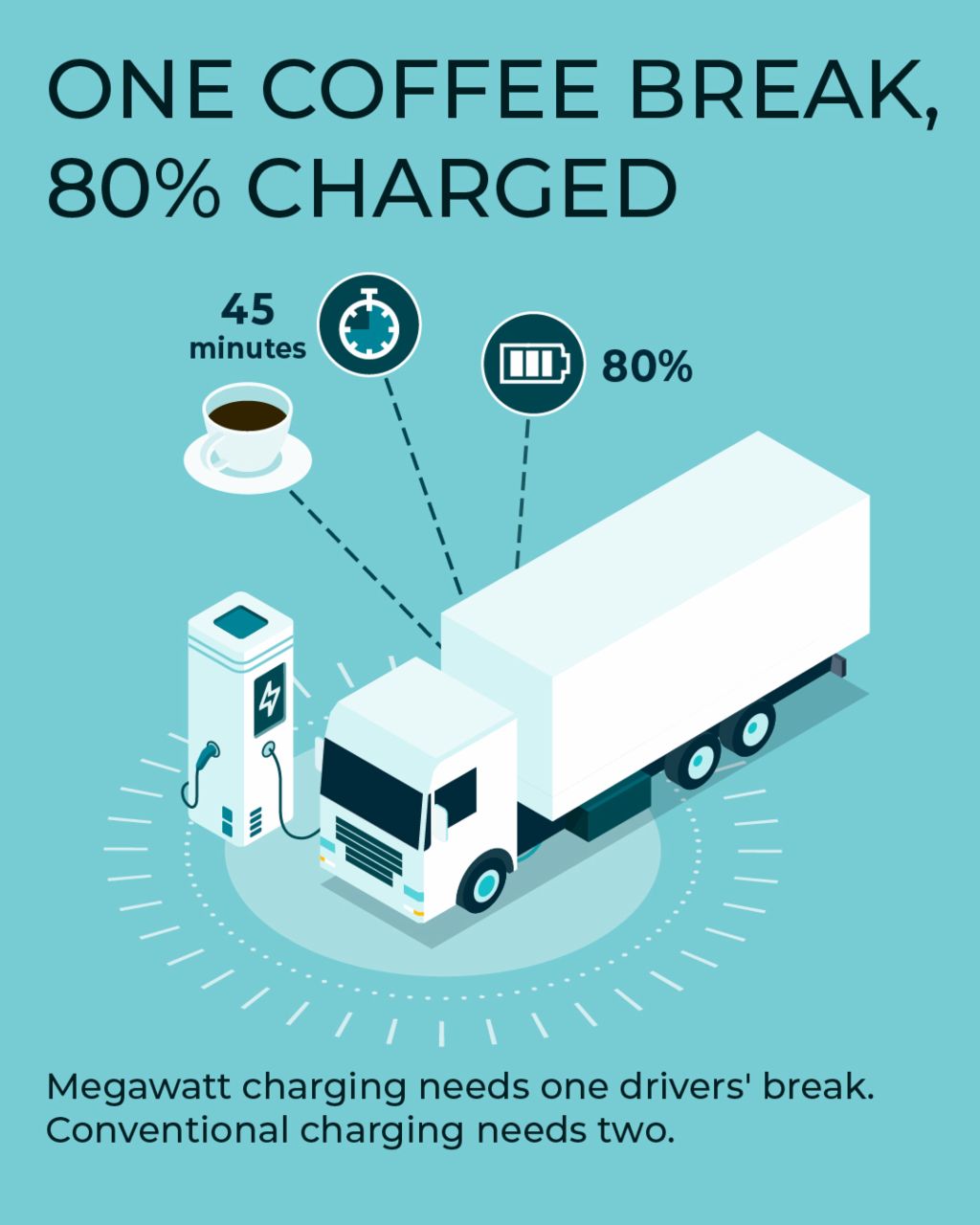
Fast charging is the answer to that question. The Megawatt Charging System (MCS) was developed specifically for heavy commercial vehicles and delivers significantly more power than a typical car charging station. This allows a heavy truck to reach a state of charge of around 80% within the 45-minute break. With conventional charging technology, the same process takes about 90 minutes – twice as long as the driver’s legally required break.
For fleet operators, this is the decisive difference: what matters is not only the price per kilowatt-hour but also the time spent at the charging point. Conventional charging, using the Combined Charging System (CCS), adds another 45 minutes of non-productive vehicle time. Over a vehicle’s lifetime, that lost operating time can add up considerably.
Missing charging infrastructure is slowing the uptake of electric trucks
This changes the equation. For years, the debate about electric trucks centered mainly around range. In long-haul transport, range is no longer the decisive factor, because a modern electric truck can carry enough energy in its battery to cover a full day of operation with one charging session. The question today is not how far a truck can drive, but how long it has to stop.
However, Europe’s major long-haul corridors still lack fast charging sites capable of delivering 750 kW or more. The first public megawatt charging points went into operation in 2025, and several thousand will be needed by 2030. This gap in the infrastructure is noticeably slowing the ramp-up of electric transport. Haulage companies look closely at the economics, and they will not order electric trucks if the charging stops at the service areas take too long.
Besides the higher power, fast charging technology offers another advantage that improves the economics: communication between the vehicle and the charging point no longer relies on a single control line, but on a far more robust, well-proven Ethernet connection. This can reduce the number of failed charging sessions – and, in turn, the time a truck spends at the service area. “A charging session that fails is costly to our customers. That is why reliability mattered to us just as much as charging speed,” says Jorge Soria Galvarro, Senior Technical Adviser for Charging Enablement at TRATON R&D.
A charging session that fails is costly to our customers. That is why reliability mattered to us just as much as charging speed.
Jorge Soria GalvarroSenior Technical Adviser for Charging EnablementTRATON R&D
Faster charging can also make infrastructure more economical
Does higher charging power mean higher costs? Not necessarily. For charging infrastructure, the opposite can be true. A small number of fast charging points can serve as many trucks as a large number of slow ones, while requiring less land, less hardware and without placing additional load on the power grid. As a result, charging sites that would never have paid off with slower technology can become economically viable – particularly along Europe’s major long-haul routes.
For fleets, this is the real lever. The stronger the business case for a charging site, the sooner it gets built – and the sooner electric trucks will find MCS charging points along their routes where they can charge at an affordable price. The economics of the charging site are therefore directly linked to the economics of the truck. And the effect grows over time: the more electric trucks are on the road, the better charging sites are utilized – and the lower the cost per kilowatt-hour can become.
“MCS charging makes a viable business case for fleet operators and charge point operators, essentially lowering transport costs for shippers,” says Benjamin Vieth, Strategy Manager for TRATON Charging Technologies. “The build-out of MCS infrastructure will determine how quickly these benefits can be realized.”
MCS charging makes a viable business case for fleet operators and charge point operators, essentially lowering transport costs for shippers.
Benjamin ViethStrategy ManagerTRATON Charging Technologies
TRATON is driving the expansion of charging infrastructure
Since April 2026, the TRATON GROUP brands have been accepting orders for electric trucks for long-haul transport, and demand is strong. The technology is here – both from a vehicle and infrastructure perspective. How fast the charging network grows now decides how quickly electric long-haul transport gets going. TRATON is therefore helping drive the expansion of charging infrastructure – together with charge point operators and service providers such as Milence and Hubject. Common standards are added on top of that. An electric truck should be able to charge at any station, no matter who operates it. Only then will many individual charging networks become one network that fleets can rely on.
The megawatt charging network: several thousand charging points needed
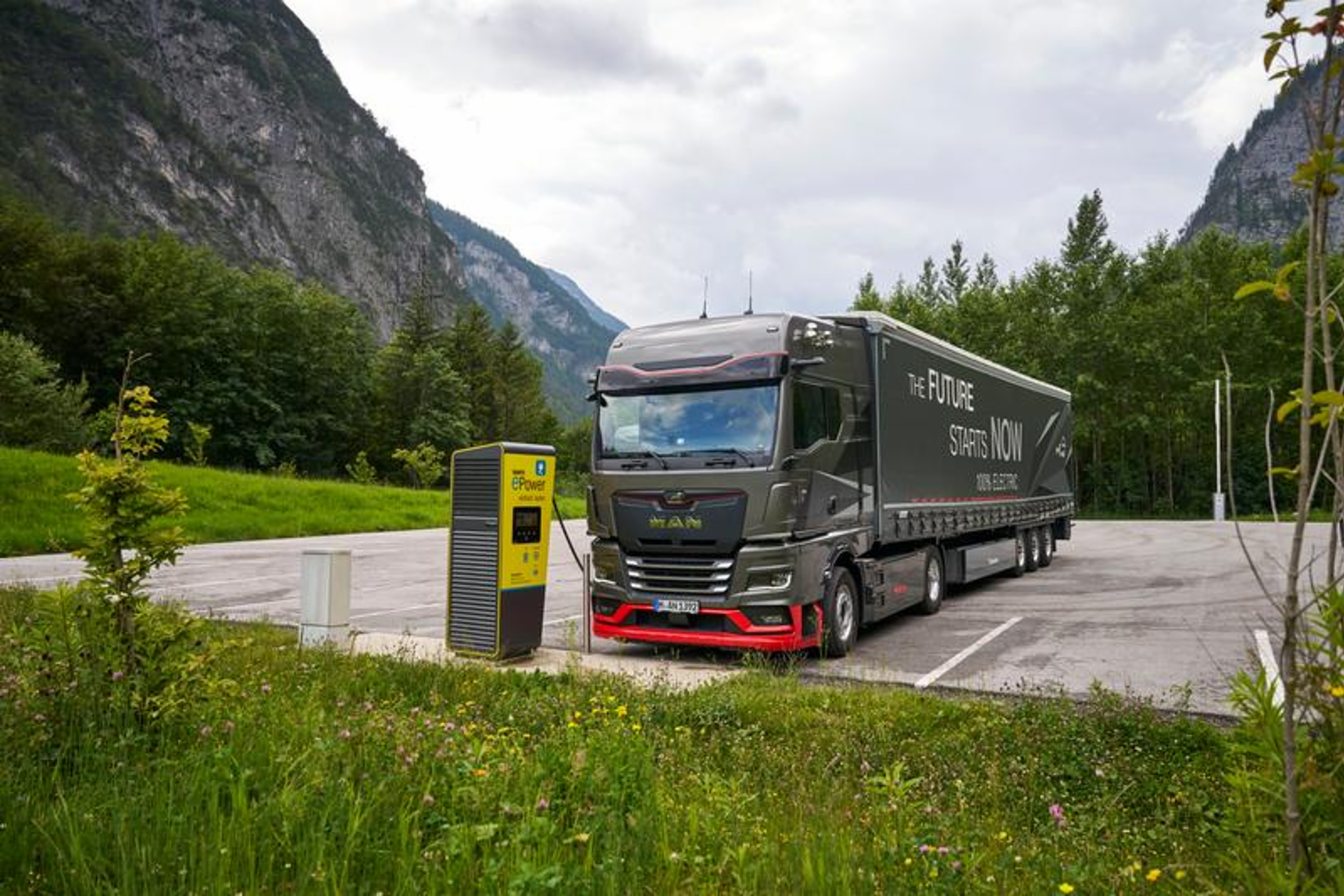
Europe’s first public megawatt charging points went into operation in 2025, with Germany’s first opening in September on the A2 autobahn. Several thousand megawatt charging points will be needed in the EU by 2030. The years between now and then are the real challenge: the vehicles can be ordered, and the charging technology is available – what is still missing is an MCS network with charging sites built for heavy trucks. For trucking companies, the availability of charging points along their routes remains one of the main obstacles to making the switch.
Two coffees or one: with megawatt charging, an electric truck reaches a state of charge of around 80% within the driver’s 45-minute break – conventional charging takes about twice as long.
The break is not going to change: it remains 45 minutes. How quickly electric trucks will be adopted in long-haul transport will depend in part on how effectively that time can be used. Making that happen is not something vehicle manufacturers can do alone. It will take everyone involved in building and operating the charging network.