Decisive factor: Megawatt charging doesn’t break the bank
Disclaimer: This page and the documents, information, data and assessments contained herein reflect the factual and legal status as well as the corporate strategy at the time of their publication and/or for the time period specified. They may since have become outdated as they are not being updated.
The Megawatt Charging System is essential to the efficient, continual operation of commercial fleets. Its convenience, safety and robustness are superior to other fast-charging options, while being more cost-effective for every stakeholder.
The Megawatt Charging System (MCS) offers enhanced communication capabilities, improved safety features, and greater system robustness. The outstanding advantage, however, is that it is more cost-effective than slower charging variants – for all stakeholders, from Charge Point Operators (CPOs) to fleet owners.
The Megawatt Charging System can enhance the operational efficiency and business continuity of commercial fleets. Both are critical for the large-scale transition towards decarbonization of the transportation sector. Jorge Soria Galvarro, Senior Technical Adviser for Charging Enablement at TRATON R&D says, “Megawatt charging is designed to maximize stability and minimize downtime.”
MCS is therefore a vital component for making this transition possible, while complying with all rules and regulations for safety and driver wellbeing.
Background
MCS is a robust, high-performance charging technology. Its charging power is much higher than that of the regular 350 kW Combined Charging System – up to 3.75 MW – making it ideal for charging large commercial vehicles.
The development of the MCS began in 2018 with the Charging Interface Initiative (CharIN). Since then, the underlying technology has been developed further by standards organizations, including ISO and IEC, with the goal of making it the global standard for high-power charging.
More than 80% charged at 700 kW within 45 minutes
Within the EU, all long-distance drivers must take a 45-minute rest period for every 4.5 hours behind the steering wheel. The Megawatt Charging System is the only fast-charging system which would allow a driver to also use this time window to substantially charge their battery-electric truck. During the rest period, a battery can be recharged to around 80% at 700 kW when plugged into a MCS.
In contrast, although a typical 350-kW charger may be suitable for passenger vehicles, charging a heavy-duty truck with a large battery of 600 kWh or more would take around 90 minutes. This is twice the length of a driver’s legal rest time. For commercial trucking operations, this extended charging time negatively impacts business continuity and incurs high opportunity costs. Therefore, with its high-performance charging at 700 kW, the Megawatt Charging System creates measurable business efficiency.
45 minutes of charging at 700 kW optimizes vehicle uptime while adhering to regulations for driving and rest time rules.
Jorge Soria GalvarroSenior Technical Adviser for Charging Enablement at TRATON R&D
MCS also offers improved robustness. The Combined Charging System standard runs over single power line connections which can be unstable, potentially leading to failed charging events. Megawatt charging is more reliable for continuous charging as it runs over ethernet connectivity – and this reduces downtime of the vehicle. The technology is also suitable for overnight charging at power levels as low as 80 kW.
Besides the improved speed and connectivity of megawatt charging, this technology provides additional economic benefits for everyone.
Economic efficiencies for Charge Point Operators
Particularly where land is scarce, land use efficiency is key. Along most major highways around Europe, space is tight. But if a vehicle charging session is much shorter due to the faster charging speeds, a truck driver can vacate the charging point sooner. This increases the throughput per square meter on that area – which utilizes the land more effectively, reducing cost.
As Andreas Kammel, VP Alternative Drivetrains at TRATON, summarizes: “Megawatt charging therefore offers tangible economic benefits to a key stakeholder in the charging ecosystem: the Charge Point Operator.” A vehicle charging station can have fewer, but faster charging points, rather than a large number of slower points, while retaining the same throughput of vehicles. Installing five 700-kW MCS chargers instead of ten 350-kW CCS chargers, for example, brings down land costs as well as physical hardware expenditure – all while retaining the same demand on the electricity network.
Charge Point Operators (CPOs) also benefit from stochastic optimization with faster charging speeds: Shorter charging times are more flexible to manage, making it easier to uphold reservation systems or adapt quickly to changing demands. This enhances the average use of each charging point – which boosts a CPO’s bottom line, with either increased margins or additional cost reductions.
Due to improved stochastics and land usage, charging at 700 kW is cheaper per kWh than at 350 kW. This allows for competitively priced megacharging without added strain on the grid, even more so as throughput grows.
Andreas KammelVP Alternative Drivetrains at TRATON
CPOs therefore reap multiple benefits from a fast-charging infrastructure, but commercial fleet managers and drivers, too, gain from the stability and convenience offered by megawatt charging points.
Value and convenience for everyone
The routes and schedules of haulage trucks are more consistent and predictable compared to those of passenger vehicles. This regularity offers further advantages to Charge Point Operators providing MCS charging points. Truck drivers would become recurring customers at their charging stations on workdays, without vacation peaks or other inconsistencies which impact passenger car charging. And if commercial customers can rely on robust charging systems that serve both en-route and overnight charging, they are likely to use public charging stations even more intensively.
In addition, trucks are concentrated heavily on fewer routes compared to passenger vehicles. This supports planning for CPOs and fleet managers: If a truck ends up missing its reservation slot due to a road accident along its designated route, for example, then other trucks heading to that charging site are likely to be stuck in the same traffic jam. The original order of booking slots for charging is therefore typically retained.
As all end-customers value their time, drivers will typically choose faster charging over slower alternatives, especially if the prices of each charging option are similar. The improved customer experience of robust, fast charging is in itself enough to encourage greater usage of MCS charging points. However, when CPOs expand their MCS charging points, it is more likely to reduce their costs, not increase them. This creates a win-win: CPOs gain improved margins and cash flow, while customers are offered greater value and convenience at the same price.
But all of these benefits can only be gained if megawatt charging becomes the standard in high-performance charging for electrified trucks. This is where TRATON comes in.
Global perspective
Other major markets in the heavy-goods sector are already expanding their charging networks with megawatt charging, as a preference over slower charging technologies. Most remarkably, this includes some nations in the Global South that are expected to debut public charging networks with charging speeds of 700 kW and higher – in many cases supported by Chinese companies entering the market. Investing in MCS thus sharpens the competitive edge for OEMs and CPOs in Europe on the global stage.
Partnerships for an improved charging ecosystem
The charging ecosystem is complex. System standards and compatibility, a solid infrastructure and cybersecurity are all key elements of a successful MCS rollout. TRATON GROUP is actively engaged in partnerships with Charge Point Operators and other service providers, including Hubject, to support a seamless customer experience across different charging networks. This helps to accelerate the rollout and adoption of electric trucking.
We aim for an interoperable market where electrified trucks can be charged anywhere so they can fulfill their transportation assignments.
Benjamin ViethStrategy Manager at TRATON
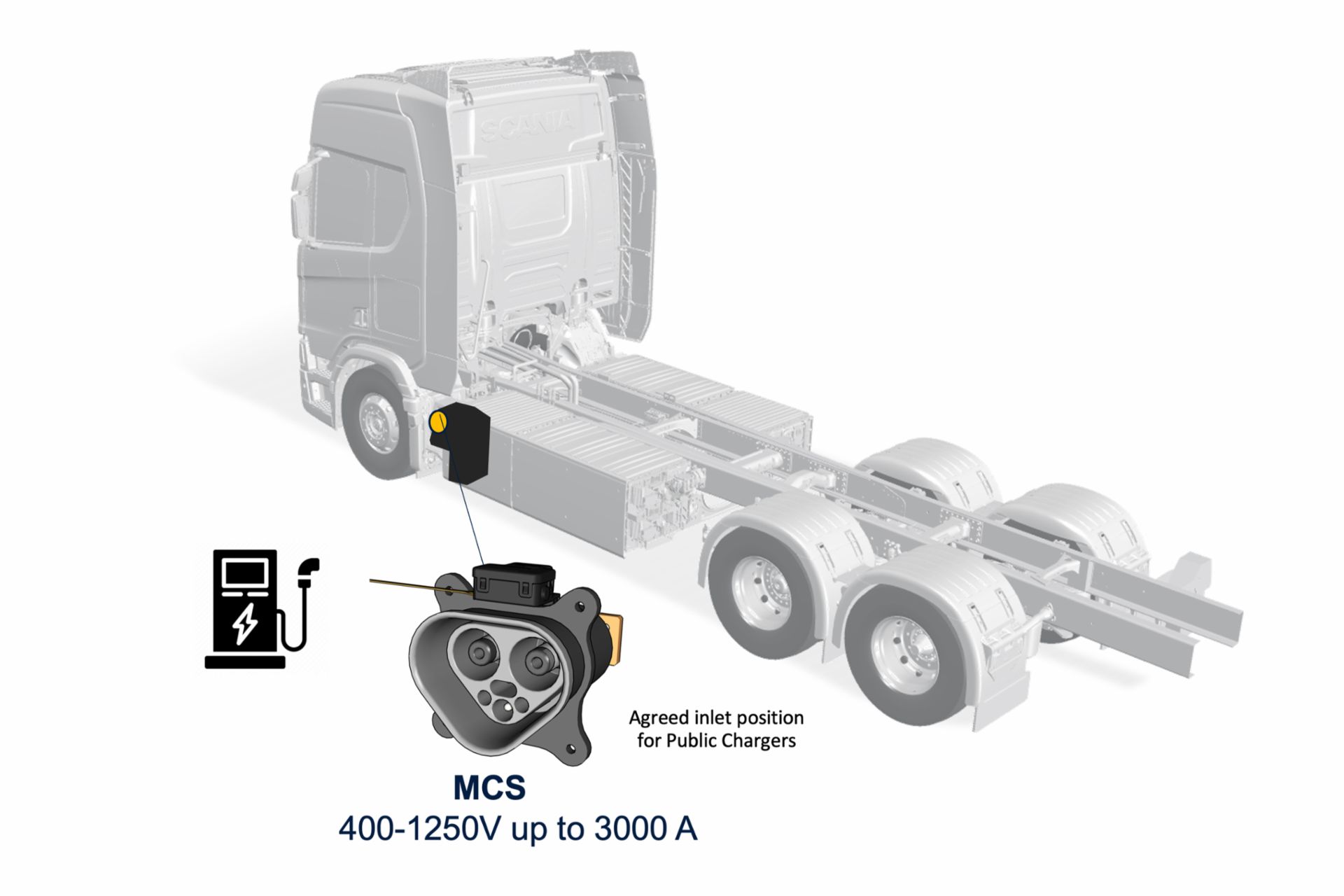
Setting standards: The charger inlet position within an MCS-enabled truck will be standard across all models, for further convenience and efficiency.
Currently, the infrastructure for the Megawatt Charging System is virtually non-existent on routes around Europe. TRATON’s Joint Venture Milence has already begun filling these gaps. It is establishing dozens of new high-performance charging stations in several EU countries, some of which are already equipped with MCS chargers. Hundreds of chargers have been built and many more are in development. This increasingly significant rollout helps promote MCS technology as a new global standard for charging heavy-duty electrified vehicles at very high-power levels.
As a leading vehicle manufacturer, TRATON has more strategies to ensure the future of long-haul trucking is electric. These include the development of next-generation BEVs, starting with the production of MCS-enabled tractor trucks. In fact, as of April 2026, TRATON brands are already accepting sales orders for MCS-enabled trucks for long-haul commercial operations.
Greater BEV adoption with optimized charging
With advanced technologies, global standards and an improved infrastructure, the charging ecosystem is set to become more cohesive. Besides the convenience of higher charging speeds, and greater robustness, there are multiple cost efficiencies for all stakeholders of an enhanced ecosystem. These will improve further as the technology scales. Investments in battery-electric vehicles (BEV) will become more appealing as a result, especially for long-haul transportation.
Looking ahead, Benjamin Vieth says, “Smart, high-performance charging, optimized energy flows at charging sites and future integrations with the energy market can all reduce charging costs by up to 40%. This lowers the total cost of ownership, thus driving further BEV adoption.”
The Megawatt Charging System, as an essential technological component, will therefore become a core pillar of an efficient electrified future.

.jpg)



.jpg/jcr:content/2024_eRH_Intermodal-(1).jpg
)
