José Ricardo Alouche – Accelerating Brazil’s E-Mobility Shift
Disclaimer: This page and the documents, information, data and assessments contained herein reflect the factual and legal status as well as the corporate strategy at the time of their publication and/or for the time period specified. They may since have become outdated as they are not being updated.
At TRATON, sustainability is a shared purpose. Impact Lines reveals how TRATON’s people bring this purpose to life, turning sustainability goals into tangible impact across every brand, every system and every line of work.
After nearly four decades in the commercial vehicle industry, José Ricardo Alouche still arrives at work with the same mindset he had as an intern in 1989: solve the customer’s problem quickly and reliably and use every day to improve the product. That customer-centric approach has shaped his journey from after-sales trainee to Vice President of Sales, Marketing and Aftersales at Volkswagen Truck & Bus Brazil and it’s the foundation of his mission today: driving the shift to sustainable mobility across one of the world’s largest and most complex transport markets.
You’ve been part of the commercial vehicle industry for almost four decades. What first drew you to the field — and what keeps you motivated during such a profound industry transition?
I started my career in 1989 in after-sales, especially in the service area for trucks and buses – which, in my opinion, was the best beginning for my career. I strongly recommend to all my team to start in that area because you learn to understand the customers needs immediately and to get a truck back on the road quickly. That shaped my whole career.
Even after almost 40 years, I’m motivated because every day brings a new challenge. Commercial work is about solving problems, improving processes, using new tools, and staying ahead of competitors. Brazil is a continental country with different cultures, climates and road conditions, and our brand needs to deliver the same quality everywhere. That responsibility keeps me energized every day.
How does sustainability factor into your daily work?
Sustainability is now integrated into everything we do. Among many other things, we include it in dealer training, and we talk about it constantly during customer visits, which are one of the pillars of our commercial strategy. These conversations often turn into real projects. For example, one customer produces 100% biodiesel (B100) and asked to operate our trucks on their own fuel. Together with engineering, we developed a program, and today several trucks run on B100 on Brazilian roads.
Another strong example is in São Paulo. A waste-collection company produces biomethane from organic waste and wanted garbage trucks that could run on that gas. We delivered the first NGV (Natural Gas Vehicles) trucks over a decade ago, and after only 60 days of recent operation, the customer already signaled interest in 170 additional units. These trucks operate in front of the population every day – quietly, without diesel emissions.
The future of mobility will be electric, and we will continue preparing our products, our teams and our customers for the transition to battery electric vehicles.
José Ricardo AloucheVice President of Sales, Marketing and AftersalesVolkswagen Truck & Bus Brazil
Volkswagen Truck & Bus pioneered electric trucks in Brazil. How did the e-Delivery and now the e-Volksbus 22L programs begin?
Our electric journey began earlier than many people think. At Fenatran in 2017, we presented a prototype e-Delivery truck simply to show future readiness. But the reaction was huge – customers immediately asked when it would be available.
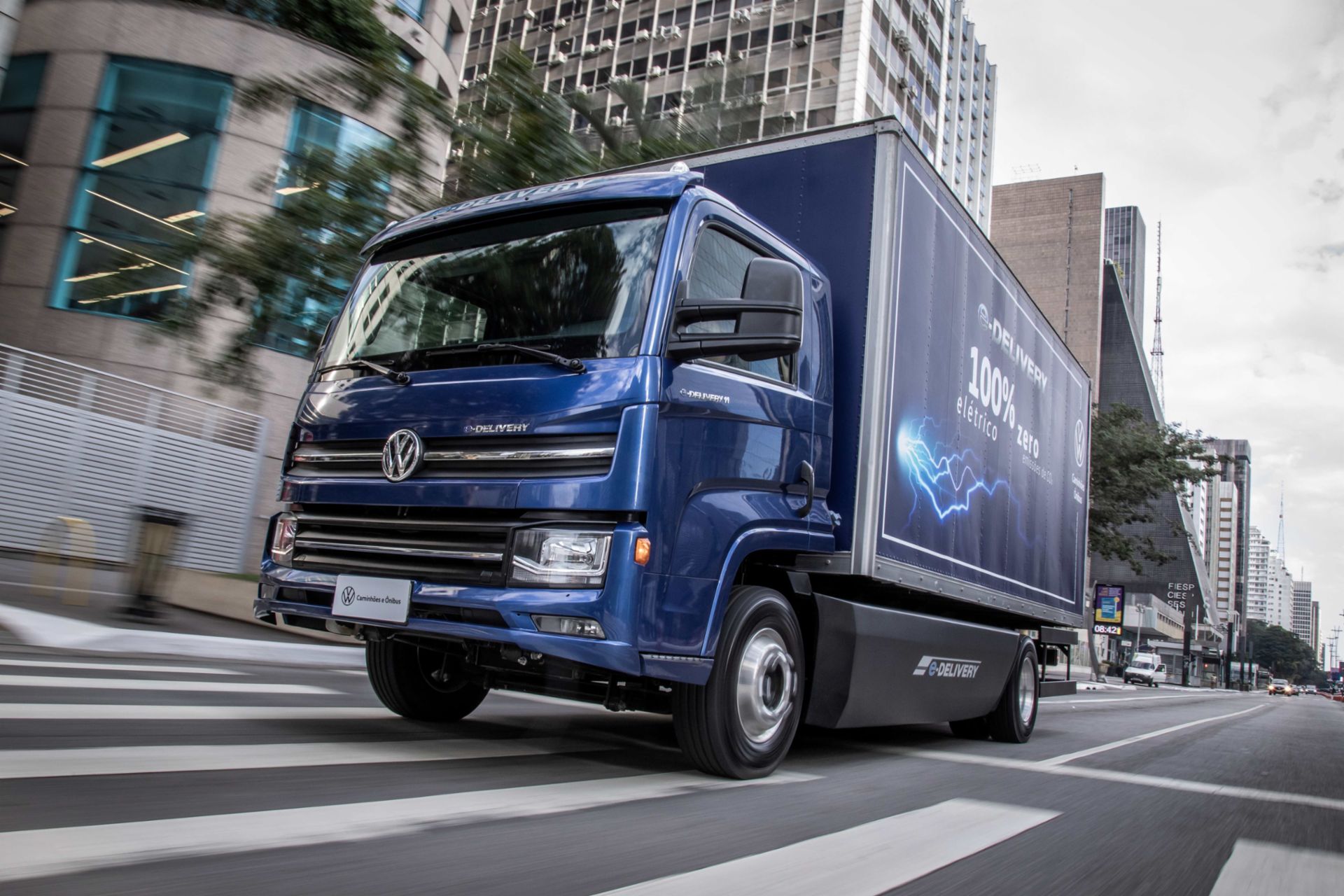
Some people said we were crazy to develop electric trucks in Brazil, but we decided to start anyway, working with suppliers and major fleets. This led to order intentions of more than 1,000 trucks from the beverage company Ambev, and by 2019 the e-Delivery entered series production. We became the first OEM (Original Equipment Manufacturer) to develop and produce electric trucks in Brazil, and we remain the benchmark today.
Our strategy focuses on urban distribution, where public charging infrastructure is not required. We install chargers directly in the customer’s depot, they charge overnight and operate during the day with zero emissions and near-zero noise. This demonstrates that electric mobility is not the future — it is already here.
The same applies to our e-Volksbus, a 100% electric urban bus beginning operations in São Paulo. By March, around 100 units are expected to be running. Electric buses help replace the old image of noisy, polluting fleets and show that public transport can be clean, quiet and comfortable.
The e-Delivery entered series production in 2019.
What measures are in place to facilitate the shift toward electric trucks and buses?
The technical collaboration inside TRATON has become increasingly important. We share components, engines and battery technology to accelerate development and reduce costs. The e-Delivery and e-Volksbus already use Group synergies, and we integrate components from MAN and Scania where it makes sense.
But one of the biggest enablers this year has been the arrival of TRATON Financial Services (TFS) in Brazil. Since its launch, financing demand has more than doubled, showing how strongly customers trust a partner focused exclusively on trucks and buses.
Financing is essential for electric adoption. TFS helps us offer tailored solutions for operators, and we are preparing to use Refrota, a national program that supports the modernization of urban bus fleets. If approved for TFS, it will significantly accelerate e-bus deployment.
Brazil faces unique challenges – including infrastructure gaps and a continental scale. Why is this sustainability work meaningful to you personally?
The climate is changing. Today we have 35 degrees at nine in the morning. Here in Brazil, we feel it every day.
We know Brazil will move at a different pace than Europe, mainly because infrastructure investment takes time. But there is no turning back. The future of mobility will be electric, and we will continue preparing our products, our teams and our customers for the transition to battery electric vehicles. A recent example was COP30, where we partnered with Heineken to supply water for participants using sustainable logistics solutions. It was a small gesture, but symbolic of our commitment. We are doing this for our children and the next generation – step by step, always forward.