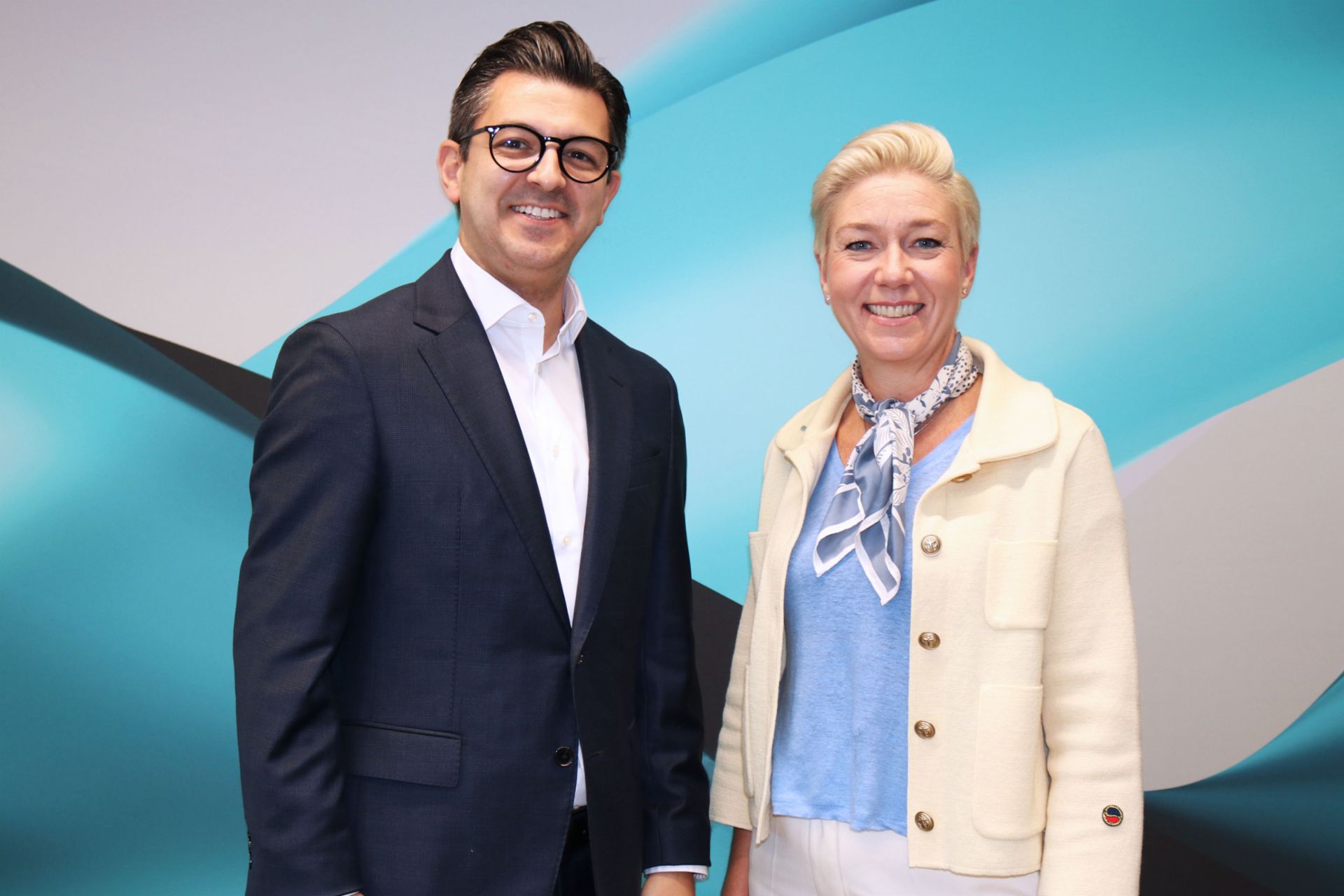
Jennie, you’re moving from your current role at TRATON to become Chief of Staff for Scania Group China.
How do you see your experience in Public Affairs translating into this new role?
Jennie: Public Affairs has always been much broader than influencing and following legislation. At its best, it is about understanding how politics, business and society interact – and translating that understanding into better decisions.
That experience will be very relevant in my new role. I am used to navigating complex stakeholder environments, identifying both opportunities and risks, building trust across different perspectives, and connecting external developments to business priorities.
At the same time, I see this as an opportunity to learn. I have spent much of my career at the intersection of business, politics, and societal transformation. Now I want to understand the business even more deeply from the inside.
Moises, you’ll be taking over the role as Head of Group Public Affairs.
What experience and perspectives are you bringing with you?
Moises: Coming to TRATON feels more like coming home than beginning something new. I started my career at Volkswagen Truck & Bus in Brazil and spent nearly four years there working in international government relations. I later worked as Head of the Brussels office for MAN Truck & Bus for five years, where I also collaborated closely with Scania. This means I am not starting from zero when it comes to building relationships and understanding the company, its culture and history. I feel a real personal connection to TRATON and its brands and I look forward to being part of the further development of our Group.
Beyond my personal connection to the company, I also bring several years of experience dealing with the issues that will occupy my time at TRATON. The automotive sector has been a passion of mine since I was a kid, and I have also tackled it from an academic perspective, having taught university courses and published articles on regulatory integration for the automotive sector in Europe and Latin America.
Finally, I consider myself a true global citizen, having lived for extended periods in Brazil, Argentina, England, the United States, Belgium and France. This allows me to better understand different people, holding distinct points of view and coming from different backgrounds. I believe this is essential when dealing in Public Affairs at the global level and also being part of a Group with a true global presence.
_2.jpg "Jennie Cato und Moises Costa")
Moises, as you step into the role…
What do you see as the most important Public Affairs challenges and opportunities for TRATON in the coming years and which topics do you expect to become increasingly important?
Moises: The world is facing a number of destabilizing challenges all at once, including wars, climate threats, trade disputes and the oil crisis, all of which affect political and economic decisions. This makes strategic choices harder for companies like TRATON but also for governments around the world. The challenge becomes focusing on what matters most and being able to stick to it.
TRATON has a clear strategy both for the short and long terms. That strategy, however, depends on possible global scenarios that can be heavily impacted by the current political context. This puts a lot of pressure on Public Affairs to help TRATON realize its vision despite potential roadblocks emanating from this convoluted global conjuncture.
Europe and China are both pushing the transformation of the transport industry, but in quite different political and market environments. Where do you see the most important differences in how that transformation is happening?
Jennie: The most important difference is probably the combination of speed, scale and coordination.
In China, the transformation is taking place in a very large and highly competitive market, with strong industrial policy, significant investment in infrastructure and a very dynamic technology ecosystem. New solutions can move quickly from development to large-scale deployment.
In Europe, the transition is also ambitious, but it takes place across 27 member states, individual policy and incentive systems and national energy markets. This makes coordination more complex.
The two regions also have different starting points. China has a very strong domestic supply chain for batteries, electric vehicles and related technologies. Europe has deep expertise in premium commercial vehicles, safety, engineering, fleet operations and cross-border logistics.
Moises: I agree, China establishes a goal and allocates huge amounts of resources to executing those. In Europe we lose too much time and resources along the way.
To accelerate the transformation in Europe, we need to find a new way of working together among European nations and industry. Ironically, the pressure from China is actually helping Europe do exactly that.
%20(1)_2.jpg "Moises Costa and Jennie Cato")
Electrification is a major part of that transformation.
How do the conditions for accelerating the shift to electric transport differ between Europe and China, and are there things the two regions could learn from each other?
Jennie: First of all, the speed. The shift is moving faster in China as China combines its five-year plans with strong policy support. They have built a large domestic battery and vehicle industry, rapidly developing charging and battery-swapping infrastructure, and have an intense competition between manufacturers.
Europe has strong technology and ambitious climate targets, but the business case remains more difficult in many heavy-duty applications. Operators face higher upfront costs, fragmented infrastructure, different national systems and uncertainty about how quickly charging networks and grid capacity will develop.
China can offer Europe valuable lessons in speed, scale, battery ecosystems, digital integration and the deployment of solutions. Europe can contribute important lessons in safety, vehicle quality, lifecycle thinking, complex fleet operations and the need for a stable, technology-neutral regulatory framework.
The key lesson for both regions is that electrification is not only about the vehicle. It is about the entire system: energy, infrastructure, financing, residual values, logistics planning and the customer’s business case.
Moises: One key difference is the fact that China has all of the pieces of the puzzle for a successful electrification strategy, and they have been developing that for many years.
This means they have much more flexibility regarding the supply chain and key technologies, coupled with a huge internal market able to absorb their production based on public policies that push for exactly that. In Europe we may have state-of-the-art technology and manufacturing, but the supply chain and public policies are not always in our favor. If we could achieve an alignment, we could be much more competitive. This is exactly the kind of conversations we are having with public officials and other stakeholders to help us get there.
Where do you expect overlaps in your future collaboration?
Jennie: There will be considerable overlap on the fundamental issues: accelerating the transition to a transport system ensuring that climate targets are matched by the necessary enabling conditions; supporting open and fair competition; strengthening infrastructure and energy systems; protecting the competitiveness of the commercial vehicle industry; and creating predictable regulatory and investment conditions.
The exact policy positions may differ depending on the market, but the underlying objective is often the same: to make future transport commercially viable and scalable.
And where will you face different perspectives from Europe and China?
Jennie: The differences will probably be most visible in the pace of the transition, the role of industrial policy, approaches to market access and local production, and the preferred regulatory instruments. We may also see different perspectives on access to data, digital ecosystems, supply-chain resilience, technology standards and the balance between global alignment and local autonomy.
Moises: Different perspectives should not be feared. As long as there is a will to work together, there will be opportunities for collaboration. Europe and China are different markets, but they are also part of the same global transformation of transport. Therefore, I prefer not to dwell on the fact that there may be differences. That is part of life. I love to find ways of converging in those differences toward a better outcome for both. That is what I focus my work on.


