Florian Stehbeck – From diesel dreams to decarbonization
Disclaimer: This page and the documents, information, data and assessments contained herein reflect the factual and legal status as well as the corporate strategy at the time of their publication and/or for the time period specified. They may since have become outdated as they are not being updated.
At TRATON, sustainability is a shared purpose.
Impact Lines reveals how TRATON’s people bring this purpose to life, turning sustainability goals into tangible impact across every brand, every system and every line of work.
Florian Stehbeck, a corporate strategist responsible for Decarbonization & Circularity at MAN, has taken an unconventional path from diesel-fueled childhood dreams to leading sustainability initiatives within one of Europe’s largest commercial vehicle manufacturers. In this interview, he reflects on his journey through digital innovation, the challenges of embedding sustainability into business processes, and the collaborative spirit across the TRATON GROUP that’s helping drive the industry toward a more sustainable future of transportation.
Florian, you mentioned that climate change wasn’t always a central concern for you. Can you tell me more about how your perspective shifted?
My dad ran a driving school, so I basically grew up with diesel in my blood. I was even close to becoming a pilot which I have always dreamed of. But during my studies in Management & Technology at Technical University of Munich (TUM), I began to develop a more critical mindset. A first turning point came when I joined a two-year scholarship program focused on shaping tomorrow’s responsible leaders. That experience helped me refine my moral compass and sparked a deeper awareness of social and environmental issues – thus also my sense of responsibility in leading positive change.
But the real perspective shift happened later at MAN, when I got the chance to help launch and lead the MAN Impact Accelerator – an initiative born from a conversation between our former CEO and Nobel Peace Prize laureate Muhammad Yunus in which we were supporting social impact businesses in the fields of transport, mobility and logistics. The goal of this accelerator program wasn’t to do business with these startups, but to learn from their mindset and impact on society while helping them grow. Working with those startups guided my attention to some of the most pressing societal challenges and the role and responsibility that the transportation sector has. After all, I started questioning my very own role and responsibility in all this – and the climate dilemma became a central concern worth facing.
How did your work in digital innovation evolve into a focus on decarbonization and circularity?
After my master’s thesis in truck platooning, I joined MAN’s team for digital transformation & new business models in 2018, focusing on startup collaboration, digital strategy and innovative customer solutions. Running the previously mentioned MAN Impact Accelerator in parallel for three years was an experience that opened my eyes to a different way of doing business: one strongly driven by purpose and optimism, where technology and innovation is used as a force for good. But first and foremost, it showed me that global challenges like climate change can be reframed as opportunities for innovation.
Eventually, there was a newly created position opening up in the corporate strategy team to lead MAN’s decarbonization and circularity efforts, which aligned perfectly with my passion for driving positive change. So I accepted the challenge ahead, knowing that it won’t be a walk in the park. It’s been an intense, but absolutely worthwhile and exciting journey so far.
Global challenges like climate change can be reframed as opportunities for innovation.
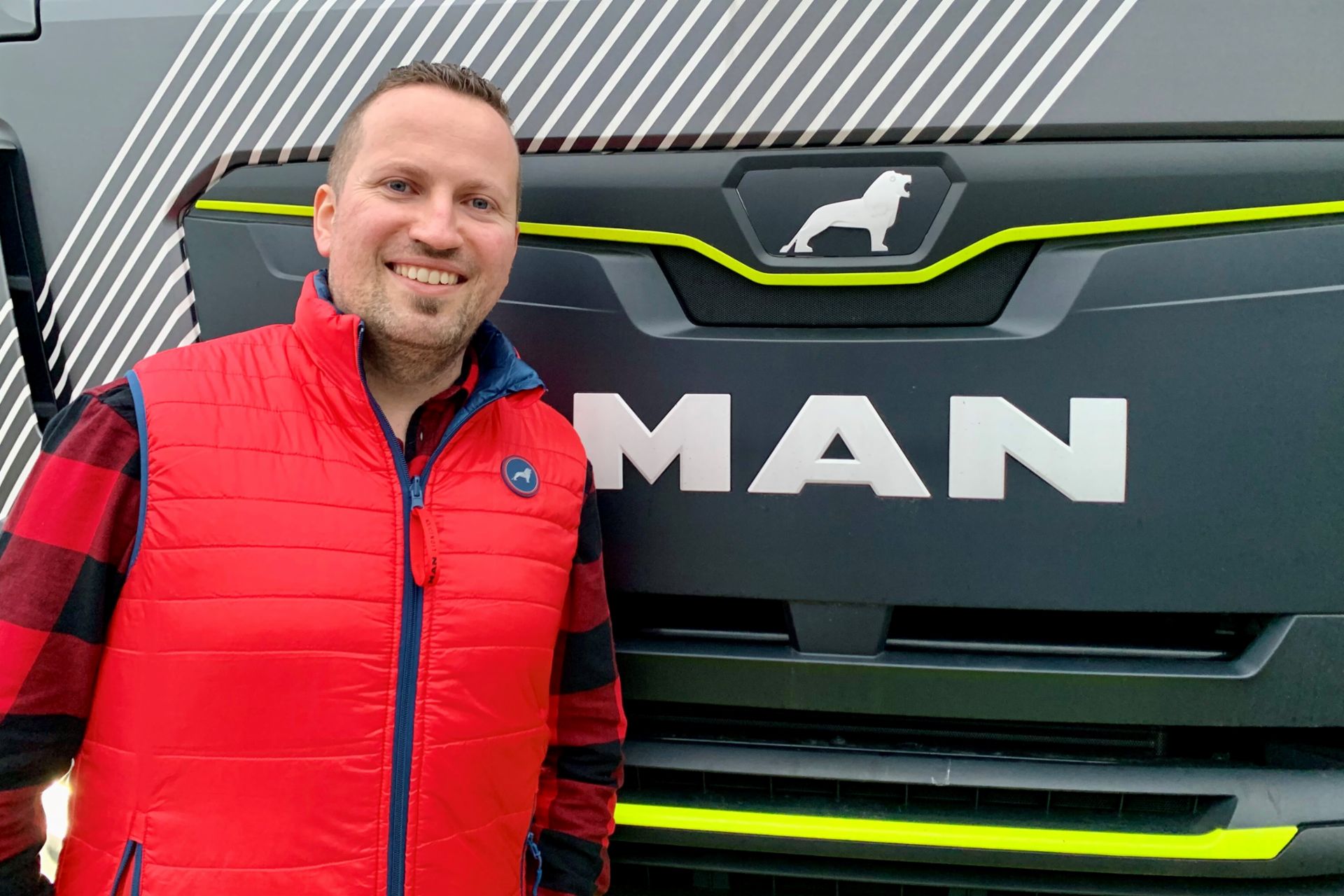
Florian StehbeckCorporate Strategist for Decarbonization & Circularity at MAN
How do you ensure sustainability targets don’t just stay on paper but actually reshape business processes?
That’s one of the biggest challenges. At MAN, we’ve anchored our science-based decarbonization targets – which have been validated by the Science Based Targets initiative (SBTi) in 2022 – into our yearly financial planning process for the next 5-10 years. For example, our target to reduce greenhouse gas emissions from the use phase of our sold vehicles by 28% by 2030 (compared to 2019) is now a minimum requirement. No planning gets approved unless it meets this target.
Beyond that, it’s a lot about education and mindset. We emphasize the scale of our responsibility: MAN with its value chain and the life cycle of its products contributes approximately 0.3% of global man-made CO2 emissions every year (status 2019) – that’s a huge responsibility given the fact that the world population emits ~42.2 gigatons annually and the transport sector causes roughly one fifth of these according to the IPCC (Intergovernmental Panel on Climate Change).
But you know, like all those big figures, they are somehow so far away for each one of us, for each individual in the organization. So you kind of need to create that tangibility. Once you understand that basically one Diesel truck (incl. all greenhouse gas emissions occurring from its creation to its end of life) is emitted by the world’s population every second, the issue of climate change gets closer to your business. Over time, we’ve seen a shift from skepticism to active engagement, with colleagues bringing forward ideas and seeking support in pushing MAN’s transformation in their daily work environment. And that has a catalyzing effect.
Why do you believe in a successful decarbonization of the transport sector?
The solutions are here. Technologically and economically, battery electric vehicles (BEVs) are already viable today – and they are the single most important driver to substantially decarbonize our industry. What’s holding us back is the challenging ecosystem: charging infrastructure, geopolitical uncertainty, and policy shifts. It’s a critical moment for the global climate, and it can be questioned if the 1.5°C target is still achievable by the global economy at all. But I’m still optimistic when it comes to our contribution to fight climate change. Once customers experience our BEVs themselves and see the financial and ecological benefits, adoption will accelerate. It’s a snowball effect across the industry – we’ve seen it in the city bus sector, and now it’s time for battery electric trucks to claim their rightful place in customer fleets.
How does the TRATON GROUP help align MAN’s sustainability roadmap with other brands?
There’s a lot of collaboration and mutual learning. Let me give you an example: Scania was the first TRATON brand to set SBTi targets, which inspired MAN to follow. Vice versa, MAN has unique remanufacturing capabilities, which Scania can leverage and benefit from. And together we support our sister brands on their sustainability journey. We push each other’s boundaries, share best practices, define methodologies, and align on emissions calculations or general sustainability measures.
The integration of engineering departments into the TRATON R&D structure has also helped. We’re developing a common vehicle platform, the TRATON Modular System, and sustainability requirements – particularly regarding decarbonization & circularity – are being embedded into the development process. It’s a fruitful setup: if one brand lags behind, another helps push it forward to bring TRATON forward as a whole. For the good of a healthy environment and a sustainable society we’re all part of.