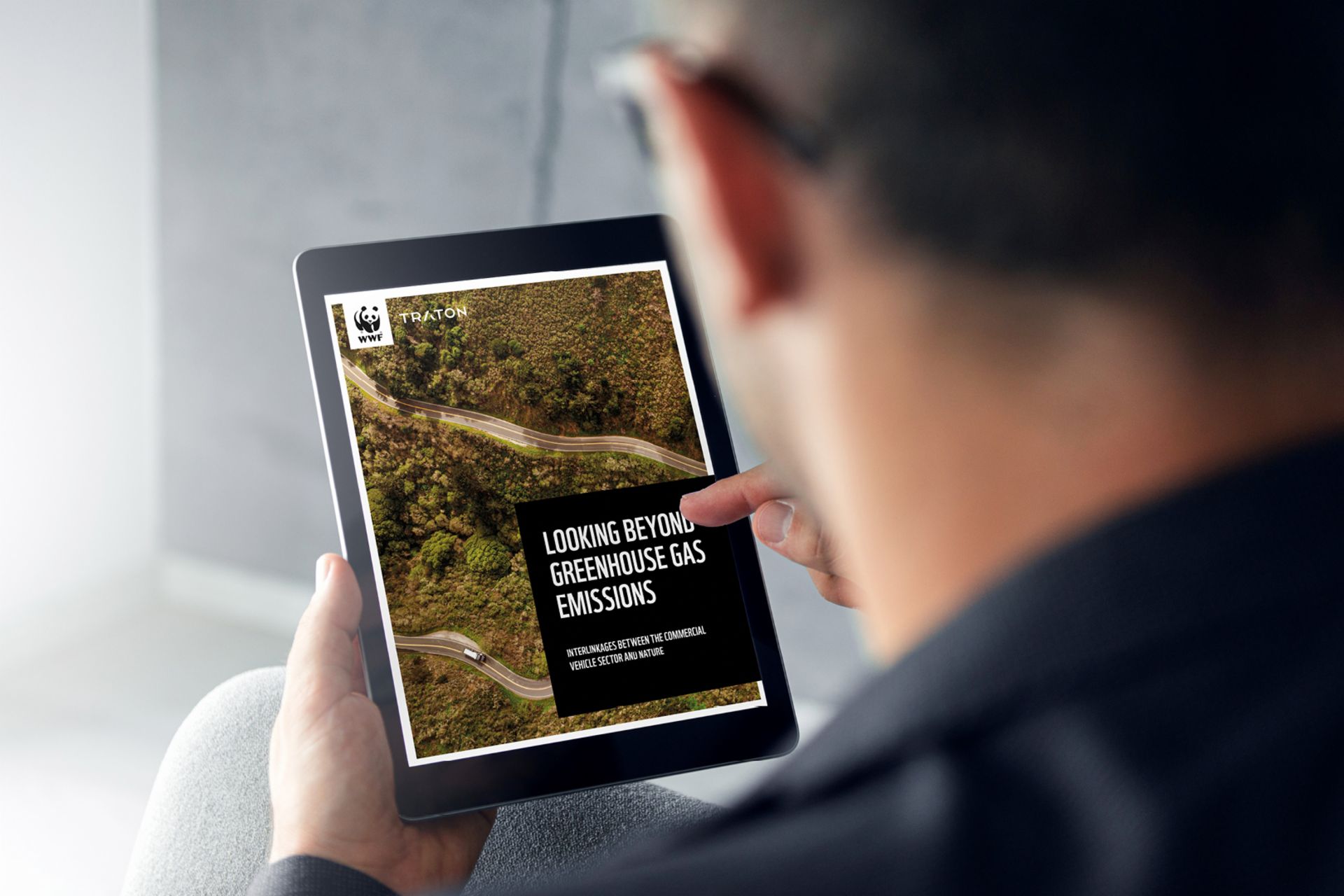
Munich, February 17, 2026 –The TRATON GROUP and the World Wide Fund for Nature (WWF) Sweden have released a new WWF-authored study titled “Looking beyond greenhouse gas emissions—Interlinkages between the commercial vehicle sector and nature.” WWF and TRATON GROUP also announced a three-year partnership, with the aim to accelerate and deepen TRATON’s, efforts to address biodiversity-related risks with a focus on resource use, water and circularity.
The study serves as a foundation for this partnership. It explores how the commercial vehicle sector both depends on and impacts nature. With risks of biodiversity loss, resource scarcity, and climate change accelerating, companies across the value chain are increasingly exposed to nature-related risks.
The transition to cleaner technologies marks important progress in reducing greenhouse gas emissions, thus addressing a key area of impact on nature. It may also introduce new environmental challenges—particularly around resource extraction, land use change, and pollution related to battery production and waste. The growing demand for battery metals such as lithium, nickel, and rare earth elements is not limited to the commercial vehicle sector; it is shared across other industries undergoing parallel transitions, such as the renewable energy industry. This cumulative demand increases pressure on ecosystems and underscores the urgency for more sustainable, cross-sector approaches.
Calling for a collective effort across the industry to navigate these challenges, the study highlights some areas where industry players can work together to reduce their impact on nature and build long-term resilience. First, sustainable sourcing involves partnering with suppliers certified according to standards that help minimize harm to the environment and local communities. Second, expanding recycling and embracing a circular economy can reduce waste and pollution, especially in components that have a high environmental footprint. Third, innovation in materials and design can lower dependency on scarce natural resources by rethinking how products are developed. Lastly, collaboration across the entire value chain is essential—by working together, stakeholders can contribute to driving meaningful progress.
“Nature loss poses real risks to business. Addressing nature challenges safeguards business from long-term risk, strengthens supply chains and opens new market opportunities. This study provides a first step in enabling companies in the commercial vehicles sector to understand why and how action is needed,” says Mats Landén, Senior Manager Corporate Partnerships at WWF Sweden.
Andreas Follér, Chief Sustainability Officer at the TRATON GROUP, adds: “Through this collaboration, we have deepened our understanding of how our sector interacts with nature. The transition to electric vehicles can be made more sustainable and needs leadership and cooperation from sector players. Moving forward, this study will not only provide insights on nature-related actions for TRATON but also for all industry players.”
The full report is now available at the following link: https://traton.com/dam/jcr:400d327f-337b-4a37-a2ea-349342143b0e/20260217_WWF-Report_Looking-beyond-greenhouse-gas-emissions.pdf
Contact
Sacha Klingner
Head of External Communications
T +49 170 2250016
sacha.klingner@traton.com
Claudia Fuhrmann
Media Relations
T +49 152 08636978
claudia.fuhrmann@traton.com
TRATON SE
Hanauer Straße 26 / 80992 München / Deutschland
www.traton.com
WWF
Mats Landén
Senior Manager Corporate Partnerships
T +46 73 3116806
mats.landen@wwf.se
Erika Reje
Communications Manager
T ++46 85 4657533
erika.reje@wwf.se
About the TRATON GROUP
With its brands Scania, MAN, International, and Volkswagen Truck & Bus, TRATON SE is the parent and holding company of the TRATON GROUP and one of the world’s leading commercial vehicle manufacturers. The Group’s product portfolio comprises trucks, buses, and light-duty commercial vehicles. “Transforming Transportation Together. For a sustainable world.”: this intention underlines the Company’s ambition to have a lasting and sustainable impact on the commercial vehicle business and on the Group’s commercial growth.
About WWF
WWF is the world’s largest and most experienced independent conservation organization, with over six million supporters and a global network active in more than 100 countries. WWF’s mission is to stop the degradation of the planet’s natural environment and to build a future in which humans live in harmony with nature. We will do this by conserving the world’s biological diversity, ensuring that the use of renewable natural resources is sustainable and promoting the reduction of pollution and wasteful consumption. As part of its effort to achieve this mission, WWF works in partnership with companies based on a common understanding of issues, shared ambitions or activities, and a willingness to speak out in public.
About the study
The study is based on global, public data from the commercial vehicle industry (medium and heavy duty) that has been analyzed via WWF's Risk Filter Suite, a tool that maps a company's – and in this case, an entire industry's – risk areas linked to nature. The study looks at different types of risks, such as increasing deforestation due to increased production of natural rubber and increasing commodity prices, or brands being scrutinized for their high environmental impact. Experts at WWF Sweden have created the contents for the report. The TRATON GROUP contributed input regarding the commercial vehicle sector.